How Much Does a Web or Mobile App Cost to Build in 2026?
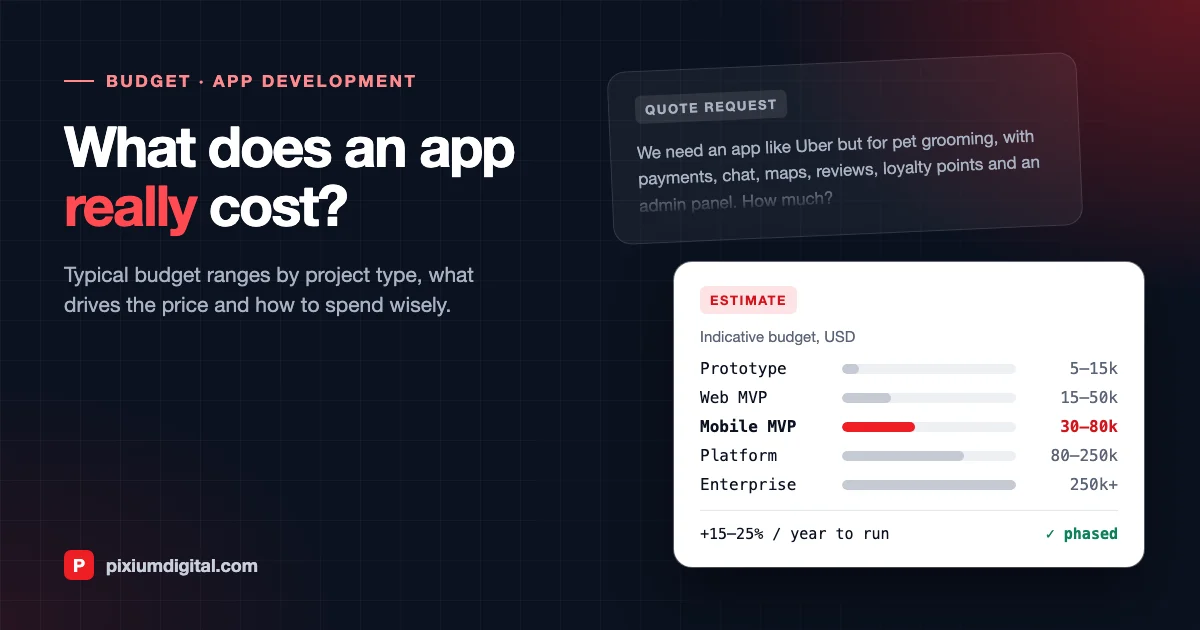
"How much will my app cost?" is the first question almost every founder and product owner asks us. The honest answer is a range: most custom web and mobile applications we see land somewhere between USD 15,000 and USD 500,000. That spread is not evasive. It reflects the difference between a focused prototype and a regulated platform serving thousands of users every day.
You want a car, but are you buying a city runabout or a performance car? Both get you from A to B. The engineering, materials and support behind them are very different. Software works the same way.
This guide explains what actually drives the price of a web or mobile app, gives indicative budget ranges by project type, and shares how to keep costs under control without putting the project at risk.
Key takeaways
- Scope is the biggest cost driver. The number of features, user roles and integrations matters more than the technology you pick.
- Plan for the full lifecycle, not just the build. Hosting, maintenance and improvements typically add 15 to 25% of the initial build cost every year.
- A short discovery phase saves money. Spending a few weeks defining scope and risks up front prevents expensive rework later.
- Cheapest rarely means best value. Choose a team that can explain its estimate, challenge your assumptions and support you after launch.
Indicative budget ranges by project type
The figures below are based on the projects we have delivered since 2015 for startups, SMEs and enterprises in Singapore, France and across Asia-Pacific. They are ranges, not quotes: your project will depend on its scope, quality expectations and constraints.
| Project type | Typical scope | Indicative budget (USD) | Typical timeline |
|---|---|---|---|
| Clickable prototype | Design-only prototype to test an idea with users or investors | 5k – 15k | 2 – 4 weeks |
| MVP web app | One platform, core user journey, simple admin, standard login | 15k – 50k | 2 – 4 months |
| MVP mobile app | iOS and Android from one codebase, backend and admin panel | 30k – 80k | 3 – 5 months |
| Business platform | Multiple user roles, payments, dashboards, third-party integrations | 80k – 250k | 5 – 9 months |
| Enterprise or regulated system | Complex workflows, legacy integration, security audits, high availability | 250k – 500k+ | 9 months + |
| AI features on an existing product | Assistant, document processing or workflow automation | 20k – 120k | 1 – 4 months |
What drives the cost of an app
1. Features and complexity
Every screen, user role and business rule has to be designed, built, tested and maintained. A booking app with one type of user is very different from a marketplace with buyers, sellers, admins, payments, refunds and dispute handling. The fastest way to reduce cost is to cut scope that does not serve your first users.
2. Platforms
Do you need a web app, a mobile app, or both? Native iOS and Android apps built separately cost the most. Cross-platform frameworks such as Flutter or React Native let one team ship both stores from a single codebase, which often reduces cost by 30 to 40% for typical business apps. A responsive web app or progressive web app can be cheaper still if you don't need device features or an App Store presence. Our mobile app development and web development pages explain the trade-offs in more detail.
3. Design and user experience
A template-based interface is quick to build. A custom design system, illustrations, animations and accessibility work take longer, but they often make the difference between an app people tolerate and one they recommend. Budget for at least one round of user testing before development starts.
4. Integrations
Payment gateways, CRMs, ERPs, identity providers, maps, messaging and AI models each add work. Well-documented modern APIs are fast to integrate. Older systems without clean APIs can take weeks on their own. If your project depends on an existing system, check its documentation early. Our integration services cover this in detail.
5. Data, security and compliance
Handling personal data under Singapore's PDPA or Europe's GDPR, processing payments, or working in healthcare and finance adds requirements: encryption, audit logs, access controls, penetration testing and documentation. These are not optional extras, and they should be in your budget from day one. Our GDPR compliance checklist is a good starting point.
6. Team location and seniority
Rates vary widely between freelancers, offshore teams and senior agencies in Singapore or Europe. Lower hourly rates can be offset by more hours, more rework and more of your own time spent managing the team. Compare the total cost of delivering the outcome, not the day rate.
7. After launch
An app is never "finished". Operating systems update every year, libraries need security patches, and users will ask for improvements. As a rule of thumb, plan 15 to 25% of the initial build cost per year for hosting, maintenance and small enhancements.
How to keep your budget under control
- Start with discovery. A structured project discovery phase turns an idea into a prioritised backlog, wireframes and a realistic estimate. It is the cheapest place to make mistakes.
- Build an MVP first. Launch the smallest version that solves the core problem, measure what users do, then invest in what works.
- Use proven building blocks. Authentication, payments, notifications and content management rarely need to be built from scratch.
- Use AI where it saves time. AI coding assistants and automated testing speed up delivery. AI features in your product, such as document extraction or support assistants, can replace manual work. Our AI workflow integration service helps you identify the use cases that pay back fastest.
- Ask for an estimate you can read. A good partner breaks the estimate down by feature, explains its assumptions and tells you what could make it go up.
- Look for funding support. In Singapore, schemes such as the Enterprise Development Grant (EDG) and the Productivity Solutions Grant (PSG) can co-fund part of qualifying digital projects. Check Enterprise Singapore for current eligibility and support levels.
Fixed price or time and materials?
Fixed price works when the scope is clear and stable, for example a well-defined MVP after a discovery phase. You get budget certainty, but changes go through a change-request process.
Time and materials works better for evolving products, where priorities change as you learn from users. You keep flexibility and pay for the effort actually spent, ideally with a monthly cap and regular demos.
Many of our clients combine the two: a fixed-price discovery and MVP, followed by an ongoing time-and-materials or team augmentation arrangement as the product grows.
How to choose the right development partner
Spending a fortune doesn't guarantee success, and neither does saving money. Look for a team that:
- asks hard questions about your users and business model before talking about technology;
- shows comparable work and lets you speak to previous clients (see our case studies and client reviews);
- is transparent about who will work on your project and how progress is reported;
- plans for testing, security and maintenance, not just the build;
- stays available after launch.
Frequently asked questions
How much does a simple app cost? A simple MVP with one core user journey typically costs between USD 15,000 and 50,000 for the web, or USD 30,000 to 80,000 for iOS and Android with a backend.
Why do quotes for the same app vary so much? Agencies make different assumptions about scope, quality, testing and support. Ask each one to list what is included and excluded, then compare like for like.
How long does it take to build an app? Most MVPs take two to five months from kick-off to launch. Larger platforms take six months or more, usually delivered in increments.
Can I reduce the cost by building in phases? Yes. Phasing is the most effective way to control cost and risk. Launch a focused first version, learn from real users, then invest in the next features.
Get an estimate for your project
Every project is different, and a 30-minute conversation is usually enough to give you a realistic range. Contact our team in Singapore or France and we will reply within 24 hours with next steps.