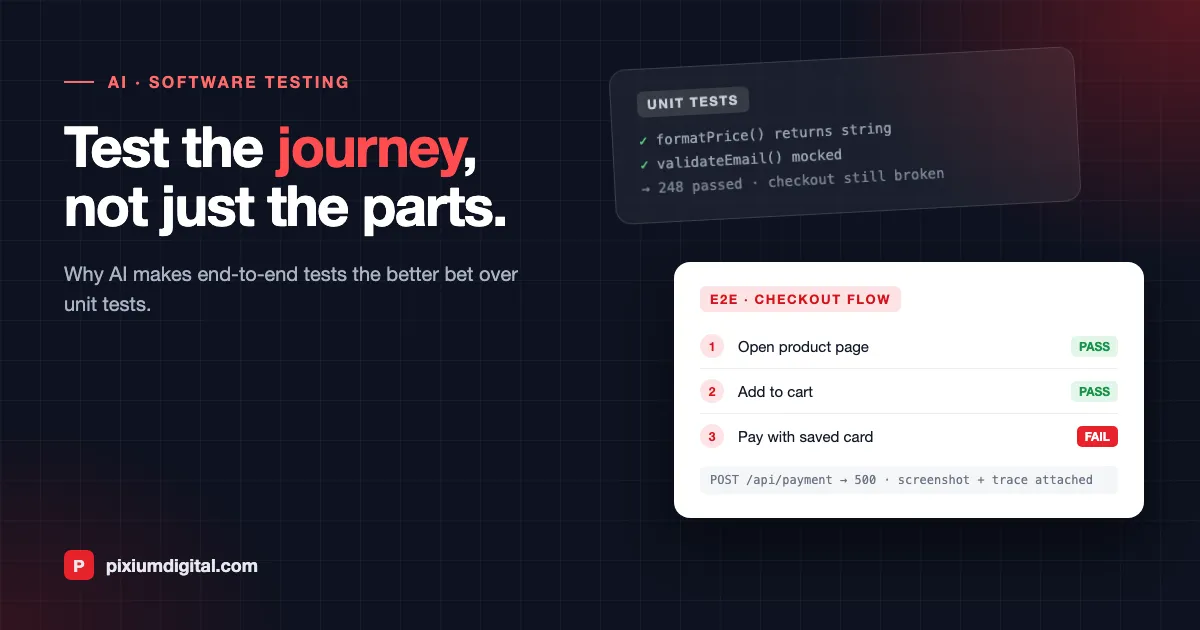
Unit Tests vs E2E Tests: Why AI Is Tipping the Balance Toward End-to-End
For two decades, the advice on testing has been the same: follow the testing pyramid. Write a large base of fast unit tests, a smaller layer of integration tests, and only a handful of end-to-end (E2E) tests at the top, because E2E tests are slow, flaky and expensive to maintain.
That advice made sense. It was built on one assumption: E2E tests cost a lot of human time to write and to keep working. In 2026, AI coding agents have broken that assumption, and the industry is starting to say so out loud.
The trigger for this article is a post from the Claude Code team at Anthropic, How the Claude Code team thinks about verification by Addy Osmani (November 16, 2026). Its advice is blunt: "If you have to focus on one test type, pick end-to-end."
Below, we summarise that post and five other recent articles on the same question, then share our own view.
What the Claude Code Team Says
The Anthropic post is about verification loops: the checks that let you trust an AI agent's work without reviewing every line yourself. The article says about 90% of the Claude Code team's code is now written and reviewed by Claude. That only works because the agent can check its own output against something it can't fake.
Three types of tests are recommended: end-to-end tests, property tests and differential tests that compare the new system against the old one. E2E comes first because it is hard to fool and gives a clear definition of done. The article also accepts the trade-off: unit tests are faster and less flaky, but an agent can make them pass and still break the feature, because neither the agent nor the test understands the whole task.
The post also says that "Running the app end to end matters more than tests." Claude is expected to start the real application and use it like a QA engineer would, through the browser, a mobile simulator or a local service, before it opens a pull request.
Five Recent Articles on the Topic
1. "Your coding agent shouldn't grade its own homework" (Stack Overflow Blog)
Jeff An, CTO of Momentic, November 13, 2026 · Read the article
This is the most data-heavy piece of the set. Momentic reviewed 1,000 unit tests written by AI agents and found that only 9.6% were useful verification checks. The rest were low-consequence (31.6%), redundant (22.8%), heavily mocked (22.4%), unused (9.1%) or written only to raise coverage (4.5%). The article also cites an experiment across 111 coding tasks where agents that wrote their own tests succeeded 65.3% of the time, versus 66.2% for agents that were told not to write tests at all.
The core argument is that an agent testing its own code shares the code's blind spots. The fix is a separate verifier that sees only the requirements and the running app, and tests real user workflows in a real browser. In the author's words, "targeted end-to-end validation is increasingly delivering better ROI than expanding unit test coverage."
Caveat: Momentic sells an AI QA product, so read the numbers as directional.
2. "The Strategic Imperative of E2E Testing in the Era of Agentic Software Engineering" (Testifly)
Amihay Schwarz, June 15, 2026 · Read the article
This article names a problem we've all seen: "AI Test Theater". When the same agent writes the feature and the tests, a green CI only proves the code is consistent with itself, not that it's correct. Typical failure modes include made-up assertions, too much mocking, deleted assertions and loops that fake success.
Its strongest technical point is about cross-module regressions. If someone changes a shared helper's signature, every unit test can stay green while the code that calls it breaks. The author argues that the pyramid has become a "testing diamond", with E2E as the widest layer, and that E2E tests should be generated from raw requirements rather than from the code.
Caveat: This is a vendor blog, and several statistics in it have no named source.
3. "The Speed Dilemma: Why AI Coding Agents Are Outpacing Your Test Suites" (DEV Community)
Tamiz Uddin, November 2026 · Read the article
This one is a useful counterweight. The author points out that agents write code much faster than most test suites can check it, so the test suite becomes the bottleneck. A suite that takes several minutes was fine for a human. An agent that iterates dozens of times an hour can't wait that long.
The recommendations focus on speed and signal quality: isolate databases per worker, run only the tests affected by a change, write failure messages as repair instructions, and keep fixtures the agent can't edit, so it can't "fix" a test by changing the expected value. A line worth remembering: "Agents are excellent at local repair given a precise signal and terrible at global search given a vague one."
4. "Self-Healing Tests with AI: Triage Before Repair" (Awesome Testing)
Sławomir Radzymiński, July 21, 2026 · Read the article
This article covers the main historical pain of E2E tests: maintenance. The author built a pipeline in which Claude Code runs only when a Playwright test fails. Before it may change anything, it has to classify the failure as a product bug, a test defect, a CI environment issue or inconclusive.
In the demo, the agent correctly refused to "fix" a real product bug. It repaired a genuine test defect, verified the fix and opened a draft PR, at a cost of under $1 and about two minutes per triage. The conclusion: "Self-healing should not mean making every pipeline green."
It's also a reminder that the author still sees isolated tests as the base of the pyramid and the blocking gate for releases, with E2E providing the business confidence on top.
5. "Agentic Testing in the E2E Stack" (TestMu AI)
Shantanu Wali, October 9, 2026 · Read the article
This article reports an experiment by Slack Engineering with more than 200 agentic E2E workflows. On a complex flow, failure rates were about 12% for an agent driving Playwright MCP, about 20% with the Playwright CLI and about 48% for Playwright tests the agent generated itself. Each agentic run also cost $15 to $30.
The proposed fix is a layered setup: let the agent explore, then replay the flows that passed and export stable ones to plain Playwright scripts, so CI runs deterministic tests. The rule of thumb: "reasoning owns the path, verification owns the verdict."
Caveat: This is also a vendor blog, and the Slack figures are as reported by it.
What the Sources Agree On
Put together, the articles agree more than they disagree:
- Unit tests alone don't prove a feature works, and AI-written unit tests are especially easy to game.
- The agent that builds the code shouldn't be the only one checking it. Tests should come from requirements, not from the implementation.
- E2E maintenance is now an AI-solvable problem, as long as the agent triages before it repairs.
- Speed and determinism still matter. Agentic browser runs are slow and costly, so the best setups record stable flows as plain, fast, deterministic scripts.
Our Take: E2E Is Now the Better Investment
At Pixium Digital, we think the pyramid was never wrong. It was a correct answer to an economic problem that no longer exists in the same form.
Unit tests were the right call when E2E was expensive
Ten years ago, writing a Selenium test for a checkout flow took a day. Keeping it working through every UI change took a lot more. One renamed CSS class could break half the suite. Faced with that, teams made the reasonable choice: test the pieces cheaply and accept the gaps between them.
AI has collapsed the cost of E2E
That cost has changed. Today an agent can:
- Write a Playwright test from a plain-English user story in minutes.
- Run the real app through a browser, the same way your users do.
- Repair broken selectors when the UI changes, after first checking that the failure isn't a real bug.
The expensive part of E2E testing was human time, and that's exactly the part AI has made cheap. Unit tests, meanwhile, have become too cheap. An agent can produce hundreds in seconds, so the number of tests says less and less about quality.
E2E tests keep the context. Unit tests lose it.
For us, this is the most important argument, and it's the one people talk about least.
When a unit test fails, you get something like expected 42, received undefined in a function three layers deep. You then have to work out which user journey this breaks, whether it matters, and how to reproduce it. The test has lost the context of why the code exists.
When an E2E test fails, you get the full story: the user opened the product page, added an item to the cart, clicked "Pay with saved card", and the payment API returned a 500. You get the step that failed, a screenshot, a network trace and the exact sequence to reproduce it. A human can read it straight away, and an AI agent gets a precise signal it can act on.
That matters even more now that agents do most of the debugging. An agent with a full user journey, a trace and a screenshot can usually find and fix the issue. An agent with an isolated assertion and no context is guessing.
E2E tests also double as living documentation. "User can reset their password from the login page" tells a new developer, a product manager or an AI agent what the system is supposed to do. test_validateTokenExpiry_returnsFalse doesn't.
Where unit tests still belong
We're not saying delete your unit tests. They're still the best tool for:
- Pure logic with many edge cases: pricing rules, tax calculations, date handling, parsers. These are also where property-based tests shine.
- Libraries and SDKs, where the "user" is another developer calling a function.
- Fast inner-loop feedback while an agent is iterating on a single function.
The change is about where you put your effort. Write E2E tests first, for every critical user journey, and add unit tests where the logic is dense enough to need them, not to hit a coverage number.
Our practical recipe
- Write E2E tests from requirements, not from code. Give the agent the user story and acceptance criteria, not the implementation.
- Keep the judge out of the agent's reach. Test fixtures and expected values shouldn't be editable in the same change that's being tested.
- Record stable flows as plain Playwright scripts so CI stays fast and deterministic. Use agentic exploration to find new paths, not as your release gate.
- Triage before repair. When an E2E test fails, the agent should first decide whether it's a product bug or a test problem.
- Invest in fast environments. Parallel browsers, seeded databases and test-impact analysis keep E2E feedback quick enough for agents.
Conclusion
The testing pyramid was designed for a world where humans wrote and maintained every test by hand. In that world, E2E tests were a luxury. With AI agents, they are cheaper to write, cheaper to maintain and far more useful when something breaks, because they keep the context that unit tests lose.
Unit tests still have a place, but they're no longer the foundation by default. If you can only invest in one type of test this year, follow the Claude Code team's advice: pick end-to-end.
Want to set up an AI-assisted E2E testing strategy for your web or mobile product? Get in touch with our team and let's talk about it.