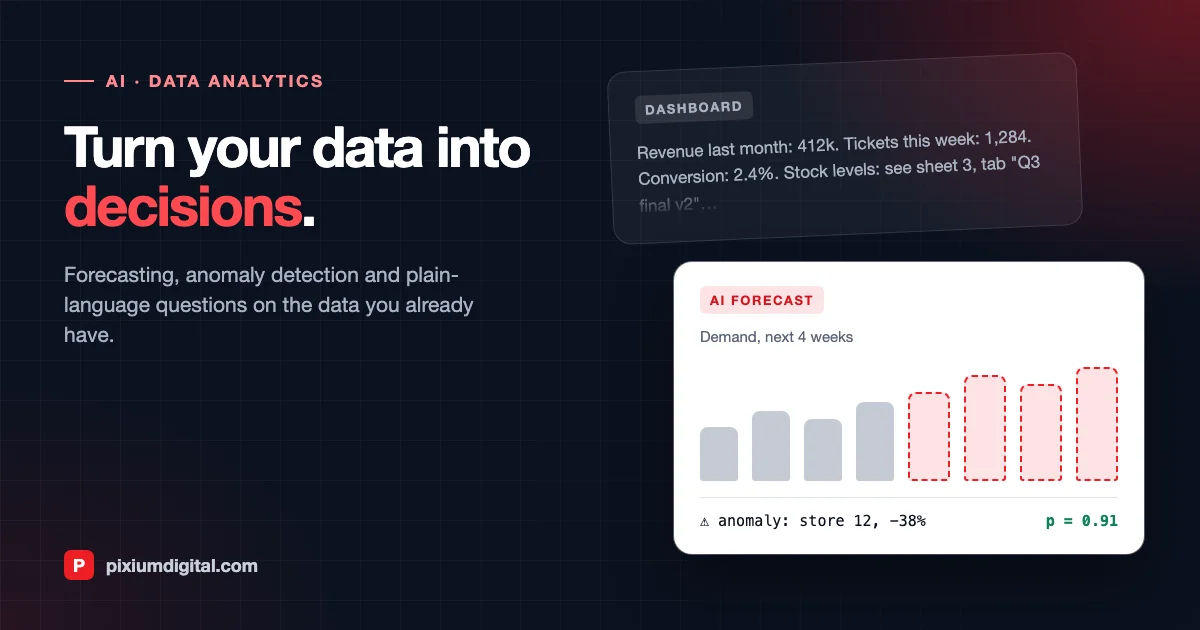
AI in Data Analytics: A Practical Guide for Business Decision-Making
Most companies are not short of data. Orders, invoices, support tickets, sensor readings, website analytics and spreadsheets pile up every day. What they are short of is the time and skills to turn that data into decisions. Traditional analytics, built on dashboards and manual reports, struggles with the volume, the variety of formats and the speed at which things change.
Artificial intelligence changes that equation. Machine learning finds patterns that humans miss, language models make data accessible to people who don't write SQL, and automation turns insights into actions. This guide explains where AI adds real value to data analytics, how to get started, and the mistakes we see most often.
Key takeaways
- Start from a decision, not from the data. The best AI analytics projects answer a specific business question, such as which customers are about to leave or how much stock to order.
- Data quality comes first. AI amplifies whatever you feed it. Clean, connected and well-governed data is the foundation.
- Begin small and measurable. A focused pilot with a clear success metric beats a large "data transformation" programme.
- Keep humans in the loop. AI should support decisions with evidence and confidence levels, not make critical calls unchecked.
What AI adds to traditional analytics
Traditional business intelligence tells you what happened: last month's revenue, this week's support volume. AI extends analytics in three directions:
- Predictive: what is likely to happen next (demand, churn, failures, late payments).
- Prescriptive: what you should do about it (reorder now, call this customer, schedule maintenance).
- Accessible: anyone can ask questions in plain language and get answers from the data, without waiting for an analyst.
Proven use cases
Forecasting demand and revenue
Machine learning models combine sales history, seasonality, promotions and external factors such as weather or holidays to forecast demand more accurately than spreadsheets. The result is less overstock, fewer stock-outs and better cash-flow planning.
Detecting anomalies and fraud
AI can monitor transactions, logs or sensor streams continuously and flag unusual patterns as they happen: a suspicious payment, a machine about to fail, a sudden drop in conversion on one page of your website.
Predicting churn and customer value
By analysing usage, support history and billing data, models identify customers at risk of leaving or with the highest growth potential, so sales and success teams can focus their effort where it matters.
Extracting data from documents
Invoices, contracts, forms and emails hold valuable data locked in unstructured text. Modern AI models extract it reliably and feed it into your systems, removing hours of manual data entry. This is often the fastest win, and it is a core part of our AI workflow integration work.
Asking questions in plain language
Large language models connected to your data warehouse let managers ask "Which regions grew fastest last quarter, and why?" and get an answer with the supporting figures. Done properly, with permissions and guardrails, this makes data useful to the whole company rather than to a few analysts.
Real-time insights from IoT data
On the Pigstech project, we processed a live stream of data from IoT sensors on pig farms, using a combination of edge and cloud computing, and applied machine learning benchmarked against a repository of scientific research. Farm managers receive insights in a mobile app, helping them track animal health in real time instead of discovering problems too late.
How to get started
1. Pick one high-value decision
List the decisions your teams make repeatedly, then estimate the cost of getting them wrong or making them slowly. The best first project combines a clear business value with data you already have.
2. Audit your data
Where does the relevant data live? Is it complete, consistent and accessible? Who owns it? This step often reveals quick wins, such as connecting two systems that never talked to each other, before any AI is involved.
3. Build a pilot with a success metric
Define what success looks like before you start: forecast error reduced by a certain percentage, hours of manual work saved, or response time improved. Run the pilot on real data for a limited scope, then compare against the current process.
4. Integrate the results into daily work
An insight nobody acts on has no value. Push predictions into the tools people already use, such as your CRM, ERP, Slack or a mobile app, with clear explanations and confidence levels.
5. Monitor and improve
Data changes over time, and models drift. Track performance, retrain when needed and collect feedback from users to keep the system accurate and trusted.
Pitfalls to avoid
- Starting with the technology. "We need AI" is not a use case. Start with the decision you want to improve.
- Underestimating data preparation. Cleaning, connecting and documenting data is often most of the work. Budget for it.
- Black-box models for critical decisions. When a decision affects customers, money or safety, people need to understand why the model recommends it.
- Ignoring privacy and compliance. Personal data falls under the PDPA in Singapore and the GDPR in Europe. Design for data minimisation, access control and auditability from the start.
- No owner after launch. Assign a business owner who is accountable for the model's results, not just a technical team.
What does it take?
A focused pilot, such as a forecasting model or a document-extraction workflow, typically takes 4 to 10 weeks with a small team, provided the data is accessible. A company-wide data platform with multiple models is a longer journey, best built step by step on the back of pilots that have already proved their value. You can read more about budgets and timelines in our guide to app development costs.
Frequently asked questions
Do we need a data scientist to use AI for analytics? Not necessarily to get started. Many use cases rely on proven models and cloud services that an experienced engineering team can integrate. For custom predictive models, data science expertise becomes important.
How much data do we need? It depends on the use case. Document extraction and natural-language querying work with the data you have today. Forecasting and churn prediction generally need at least one to two years of reasonably clean history.
Is our data safe when using AI services? It can be, with the right architecture: enterprise-grade providers, data processing agreements, regional hosting, encryption and strict access control. These choices should be made at design time.
How do we measure ROI? Tie each project to a business metric agreed up front, such as hours saved, forecast accuracy, stock levels or revenue retained, and measure it against the current baseline.
Turn your data into decisions
Pixium Digital helps companies in Singapore, France and across Asia-Pacific design and build AI-powered analytics, from data pipelines to predictive models and natural-language interfaces. Explore our AI, process automation and data intelligence services or contact us to discuss your use case.